A customer asked us last year to quote a range of windshield wiper blades for an electric sedan platform. On paper it looked simple. Same blade lengths as the petrol version it replaced, same hook type, same catalogue reference. We sent samples, they fitted, the wipers wiped clean.
Three months later the returns started arriving with the same complaint. The blade clicked onto the arm but you could rock it by hand, and above about 110 km/h it lifted off the glass. Nothing was wrong with the rubber. The problem was that nobody had measured anything on the actual vehicle.
That is the part most aftermarket catalogues miss. On electric platforms the blade itself has barely changed. Everything around it has: the glass rake, the cowl, the connector, the sensor package, and how much noise the cabin lets through. If you are building a wiper blade program for EV fitments, those four things decide whether you get reorders or credit notes.
Why EV wiper blade programs start with fitment data
Most wiper catalogues are built on three fields: blade length, arm type, model year. That logic carried the aftermarket for thirty years and it still works for a lot of ICE vehicles. On electric models it starts to leak.
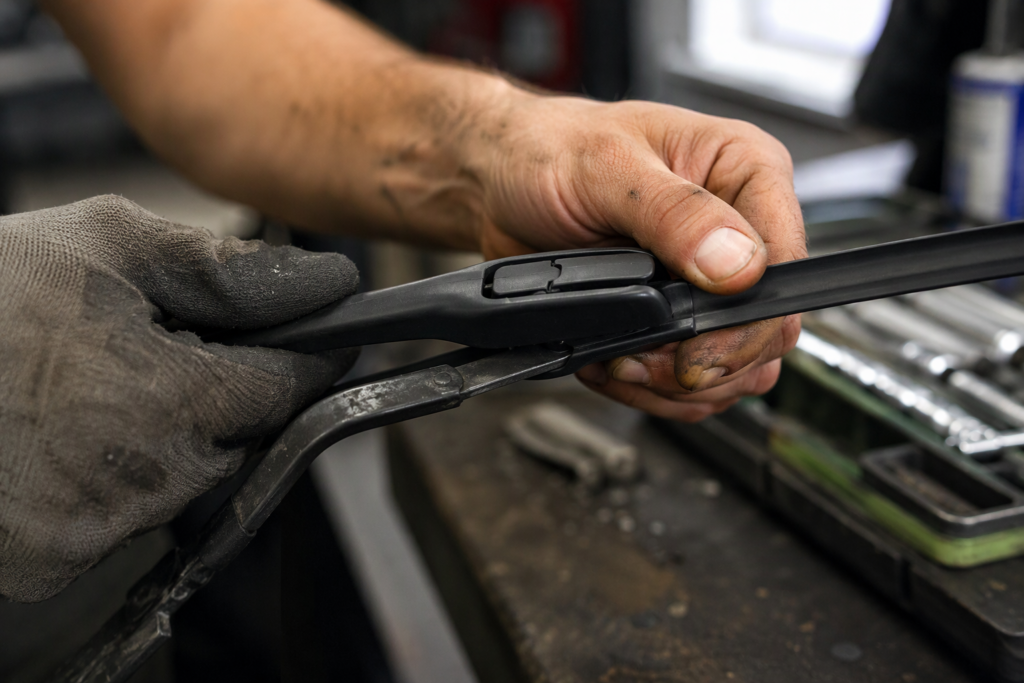
Two cars can take the same 600 mm blade and still need different references. The arm may park two centimetres lower under a longer cowl. The clip may sit at a different depth in the arm. The glass may curve away from the blade at the outer tip. A catalogue that matches on length alone will tell you the part fits, and technically it does. It just does not stay seated, or it leaves a strip unwiped, or it fouls the cowl when the arm is lifted.
The fix is unglamorous. You build a wiper blade fitment record for every nameplate you intend to sell, and you build it from measurements taken on the car, not from the ICE model the electric version replaced. Arm type and connector code, front and rear length, park position, glass radius at the middle and at the tip, cowl clearance at full lift. One page per vehicle. If a supplier cannot give you that page, they are guessing on your behalf.
Raked glass changes the contact patch
Electric cars are designed for drag, and that pushes stylists towards longer, more raked windshields with lower cowls. A more raked screen changes how pressure is distributed along the blade. Flat wiper blades, the beam type with a continuous spring spine and no hinges, usually cope better here than a framed blade, because the load runs along one curve instead of jumping between hinge points. Most new EV platforms are specified with beam blades for exactly this reason.
“Usually” is not a specification though. Glass curvature varies a lot between models, and a beam blade tuned for one screen can leave the ends skipping on another. Check the sweep on the car with the arm at normal pressure. If you are buying a universal beam blade and selling it as custom fit, expect the ends to be the first thing your customer notices.
Connectors, cowl clearance and park position
This is where most fitment failures actually happen, and it has little to do with the blade.
Some electric platforms use push-button or pin arms that look identical to hardware you already stock, but the retention depth and the release tab geometry are different. Others tuck the arm under a deep cowl panel, which limits how far a technician can lift it before the arm touches plastic. A blade that needs 40 mm of lift to clip on will not go on a car that only gives you 25 mm.
The output you want from this work is a small matrix: arm type, connector code, blade length pair, park position, cowl clearance note. Our own wiper blade adapter types guide maps the connector families, J-hook, pinch tab, push button, side pin and the multi-clip systems. The EV work is narrower than that. It is confirming which variant each nameplate uses, and whether the clip stays seated under load. An adapter that clicks is not the same as an adapter that holds.
Wiping coverage around cameras and rain sensors
On a growing number of electric models the forward camera, the rain sensor and sometimes a radar module sit in the upper centre of the windshield, inside the driver-side sweep. That one detail changes how you specify coverage.
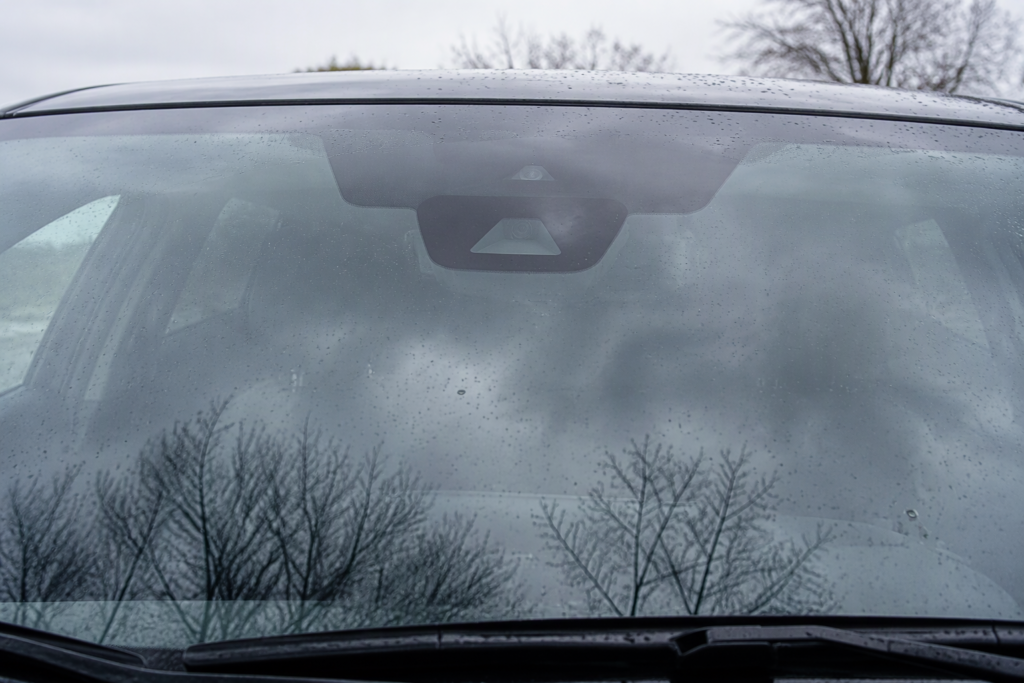
A blade that leaves a film or a smear band across the camera window does not just look bad. It can degrade lane keeping and automatic emergency braking, and the driver will report it as a wiper fault whether or not the wiper caused it. Dealers then replace the blade, the fault comes back, and everyone loses confidence in the part.
Defining the clean zone
Ask the workshop or fleet operator what the manufacturer specifies for the sensor window, then turn that into a coverage requirement you can check. Does the blade tip pass beyond the camera housing at the top of the sweep? Does the parked blade leave a water channel that runs back across the sensor when the car is moving? On some models the passenger blade contributes to camera cleaning. On others it does not. Confirm it on the vehicle rather than from a photo, because the photo will not show you the sweep.
Installation matters as much as geometry. An arm lifted past its stop can disturb a camera bracket, and the recalibration that follows costs more than the blade. A short fitting card in the box, plus a thirty-second video, prevents a category of complaint that would otherwise land on your product.
Noise becomes a specification
An engine masks a lot. In an electric car at low speed the cabin is quiet enough that a blade juddering across a half-wet screen, or whistling above highway speed, turns into a warranty conversation instead of a shrug.
This is the shift that catches suppliers who only work to price. On a price-led ICE program, noise is a complaint you handle when it arrives. On an EV program it is a line in the specification, sitting next to length and connector code, and it gets tested before the order ships.
Beam, hybrid or framed
Beam blades dominate EV fitments, but the choice is not automatic.
| Construction | Where it suits an EV program | What to watch |
|---|---|---|
| Beam (flat) | Raked glass, quiet running, high-speed stability | Needs the arm pressure window confirmed; ends can lift on unusual curvature |
| Hybrid | Buyers who want a beam profile with a more familiar look, cost-sensitive ranges | Heavier than a beam blade; validate wind lift at speed |
| Framed (traditional) | Older or mixed fleets, universal fallback references | More hinge points, more wind noise, less even contact on curved glass |
A beam blade with an integrated spoiler and a continuous spine usually reduces lift and flutter compared with a multi-hinge frame, which is why it is the default on new platforms. The trade-off sits on the arm side. Beam blades have a narrower tolerance for arm spring pressure, so if the vehicle’s arm is outside the blade’s design window you get chatter at one end and lift at the other. Ask for the design pressure window in writing.
Judder at walking speed
Judder shows up at the worst possible moment: low sweep speed, a screen that is half wet, driver pulling away from a junction. It is also rarely the blade alone. Arm angle, glass contamination, the coating left behind by a car wash, and rubber hardness all contribute.
Do not argue about it after delivery. Agree an acceptance test before the order: a dry sweep, a wet sweep and a half-wet sweep at low speed, all judged from inside the cabin with the climate control off. If two people watch the same blade and disagree, the test was not defined well enough.
Rubber compound, coating and wipe quality
When complaints move from wear to noise, the compound and the coating carry more weight than they do on a cost-driven program.
A softer compound with a graphite or similar low-friction coating tends to run quieter and resist chatter, at some cost in wear life. A harder compound lasts longer but can be noisier on dry glass. Neither is right in the abstract. The answer depends on the climate the program serves and the warranty position you are willing to hold. Some of our silicon rubber strips go into markets where the summer kills conventional rubber in a season; the same compound would be money wasted in a mild climate. Our wiper blade rubber material comparison sets out those trade-offs in more detail.
One production point deserves a place in any supplier audit. A coating applied unevenly creates a chatter band rather than a quiet sweep. Ask how the coating is applied and how it is inspected, not only which material the data sheet names. If the answer is a material name and nothing about inspection, you have learned something useful.
Shaping the aftermarket range
EV model counts are still smaller than ICE counts, but they move faster. One platform can be sold under three badges in the same market, and a facelift can change the arm without changing the nameplate. That combination rewards breadth of reference coverage and punishes depth in slow stock.

A workable default for a distributor entering the category: front pairs for the highest-volume EV nameplates in your market, a length-based universal range behind them as a fallback for everything else, and a review cycle tied to new registrations rather than to your calendar. When a new nameplate appears, that is the signal to check fitment.
Two things that get missed. Fleets buy in blocks, so one purchase order can call for forty identical vehicles. A single missing reference costs you the whole account while the wrong one sits on the shelf. And front and rear often differ on the same car, with rear blades frequently absent from catalogues entirely. If returns are already hurting you, the discipline in our returns reduction guide applies directly to EV references.
A sample approval checklist that catches EV problems
Sampling an EV range should not look like sampling a legacy range, because the failure modes are different. A blade can fit, wipe cleanly, and still be rejected. It clips too tightly. It fouls the cowl at full lift. It is audible at motorway speed.
Run this per nameplate before anything is signed off:
- Arm type, connector code and retention confirmed on the vehicle, not from a catalogue
- Front and rear length checked against the glass, park position recorded
- Full sweep checked against the camera and sensor window, and photographed
- Cowl clearance verified at maximum arm lift, with the hood open and closed
- Dry, wet and half-wet sweep at low speed, judged from inside the cabin
- Road test at highway speed for lift, flutter and whistle
- Two-week trial on the vehicle in the target climate where logistics allow
A simulated rain rig screens batches well, and we run one, but it cannot reproduce wind load or cabin acoustics. The limits are set out in our wiper blade testing standards article. For an EV fitment, the field trial is still the deciding evidence.
What to put in the RFQ
Procurement conversations go faster when the questions are specific. Send these with an RFQ for an EV-oriented range, whether you are buying OEM or ODM:
- Which arm and connector variants does the blade support, and how is retention tested at speed?
- What is the design arm pressure window, and does it match the target vehicle?
- Is the construction beam or hybrid, and what lift behaviour is documented at highway speed?
- Which rubber compound and coating are used, and how is coating consistency inspected?
- What is the declared service life, and against which test cycle?
- Can you supply fitment data in a structured format for our catalogue?
- What is the sample lead time, and what does an approval sample include?
- Which OEM and ODM branding options exist, and what MOQ does each carry?
If the answers stay vague on connector retention, arm pressure or coating inspection, the program will be paid for later in returns. First-order mechanics and MOQ structure are covered in our wiper blade wholesale guide, and branding options in the custom packaging article.
Bringing the plan together
The blades an electric car needs do not look dramatically different from the ones it replaced. The program around them does. Fitment data built from measurement instead of inheritance. Coverage defined around the sensor window. Noise treated as something you can specify rather than something you apologise for. An inventory shaped for a model range that is still narrow but moves quickly.
Teams that plan for those four differences tend to find the EV category less disruptive than they expected. The advantage is not in the rubber. It is in owning the fitment data before your competitor does.
If you are building a range for a specific market, start from the nameplate list and the climate it will serve, then confirm which references need on-vehicle verification before you quote. That order saves more money than any price negotiation.