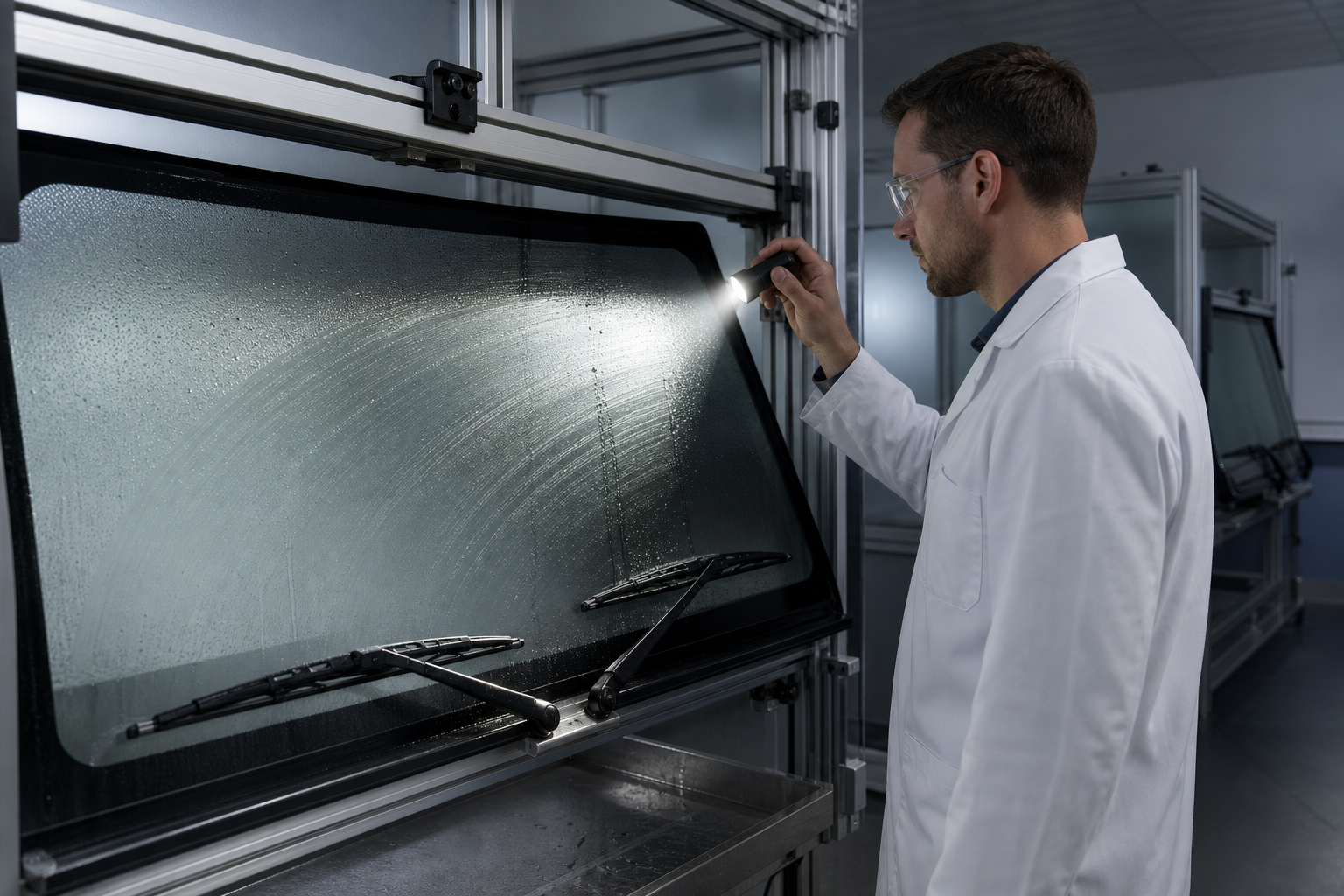
There is a windscreen bolted into an aluminium frame. Ten nozzles above it drop water in steady streams. Two blades sweep up and down, and the glass behind them goes from wet to clear, then wet again. Later in the run a jet comes in from the side at an angle, the way spray hits you when a truck passes at speed.
That rig is the closest thing to a rainy motorway you can build indoors. It is also the first thing a buyer should ask to see before signing off a wiper blade order — not because it looks impressive, but because almost every quality argument in this product category gets settled on it.
Below: what such a rig actually simulates, how wipe quality is scored, which published standards sit behind the numbers, and where the bench quietly stops being useful.
What the rig is simulating
The windscreen is mounted at the rake angle it would have in the vehicle, not lying flat on a bench. That matters more than it sounds. The angle decides where water pools, how fast it runs off, and how much of the blade’s weight actually rests on the glass.
Water arrives from a nozzle bar above the glass at a controlled rate, and the blades are driven by a motor rather than by a car’s linkage. In the steady phase you are watching ordinary rain wiping. In the second phase, a high-pressure jet enters from the side — that is wind-driven rain, or the wall of spray thrown up by a lorry on a wet motorway. Some rigs add a third variable and run the blades at highway wiping frequency for hours, which is where chatter and lift start to appear.
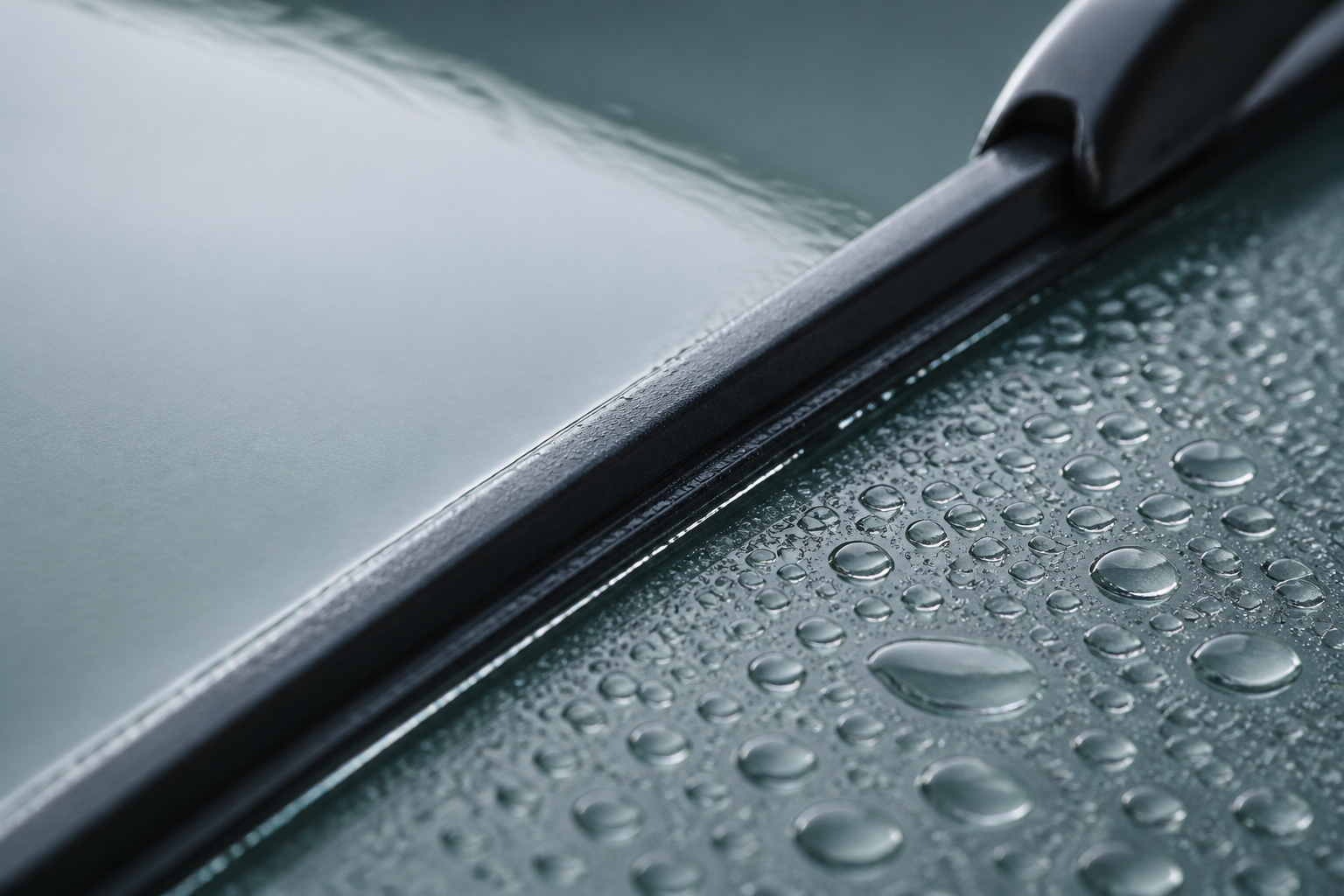
What you read off the glass at the end: how much of the swept area actually came clear, whether water was pushed into bands, whether the blade left fine lines, and whether the tip lifted at the end of the stroke.
Four things a bench run can prove, and two it cannot
A rig with good instrumentation can demonstrate:
- Wipe quality — residue, streaks and chatter lines on the glass, graded rather than eyeballed.
- Wiped area coverage — whether the driver’s field is genuinely cleared, not just “mostly clear”.
- Durability — how the grade holds up after a defined number of cycles.
- Conditioned performance — behaviour after the blade has been aged by heat, ozone or UV, which is closer to what a customer receives in month eight.
It cannot demonstrate two things, and pretending otherwise is where suppliers get into trouble:
- Real vehicle variables. Arm spring pressure on a twelve-year-old car is not the pressure on your rig. Neither is the curvature of a windscreen that has been through a hail season, nor the seating depth of an adapter fitted in a hurry.
- The service environment. Car-wash hot wax, tree sap, insect residue, road film and a full summer of UV all change an edge. None of them are in the tank.
Wipe quality is graded, not pass-or-fail
Independent rubber laboratories grade a blade from one to ten, on a real windscreen fitted for a specific vehicle. A ten means no streaking, no chatter lines and no water remaining in the wipe pattern. Grades fall away as residue, smears and chatter lines appear.
| Grade | What you see on the glass | Usual cause | What it tells a distributor |
|---|---|---|---|
| 10 | Glass clears almost instantly behind the blade, no lines | Compound conforms, edge geometry correct, arm pressure in range | Bench-clean at day one; the baseline you want |
| 8–9 | Faint film or a few fine lines toward the ends | Slight edge hardening or minor pressure loss at the tip | Acceptable at dispatch, but track the field return rate |
| 6–7 | Visible streaks in two or three bands | Edge contamination, compound too hard for the temperature, or a bent yoke | Fix before shipping, not after |
| 4–5 | Heavy smearing; water pushed rather than wiped | Compound hardened, edge rounded over, or wrong blade for the arm | Reject the batch |
| Below 4 | Chatter or skipping, large unwiped patches | Structural: wrong length, adapter seated off, damaged frame | Root-cause the fitment, not just the rubber |
One caution about this scale: a single overall grade is close to useless. If a hundred blades were graded, the number you want is the distribution — how many scored ten, how many fell below seven. A supplier who reports “average grade 9” has told you nothing about the tail, and the tail is what generates your returns.
The numbers behind “the whole windscreen gets cleared”
In the United States, Federal Motor Vehicle Safety Standard 104 sets the floor for new vehicles. Three requirements are worth knowing even if you never sell into that market:
- at least two wiping speeds;
- one speed not less than 45 cycles per minute regardless of engine load and engine speed;
- the highest speed and one lower speed must differ by at least 15 cycles per minute, and that lower speed must be at least 20 cycles per minute.
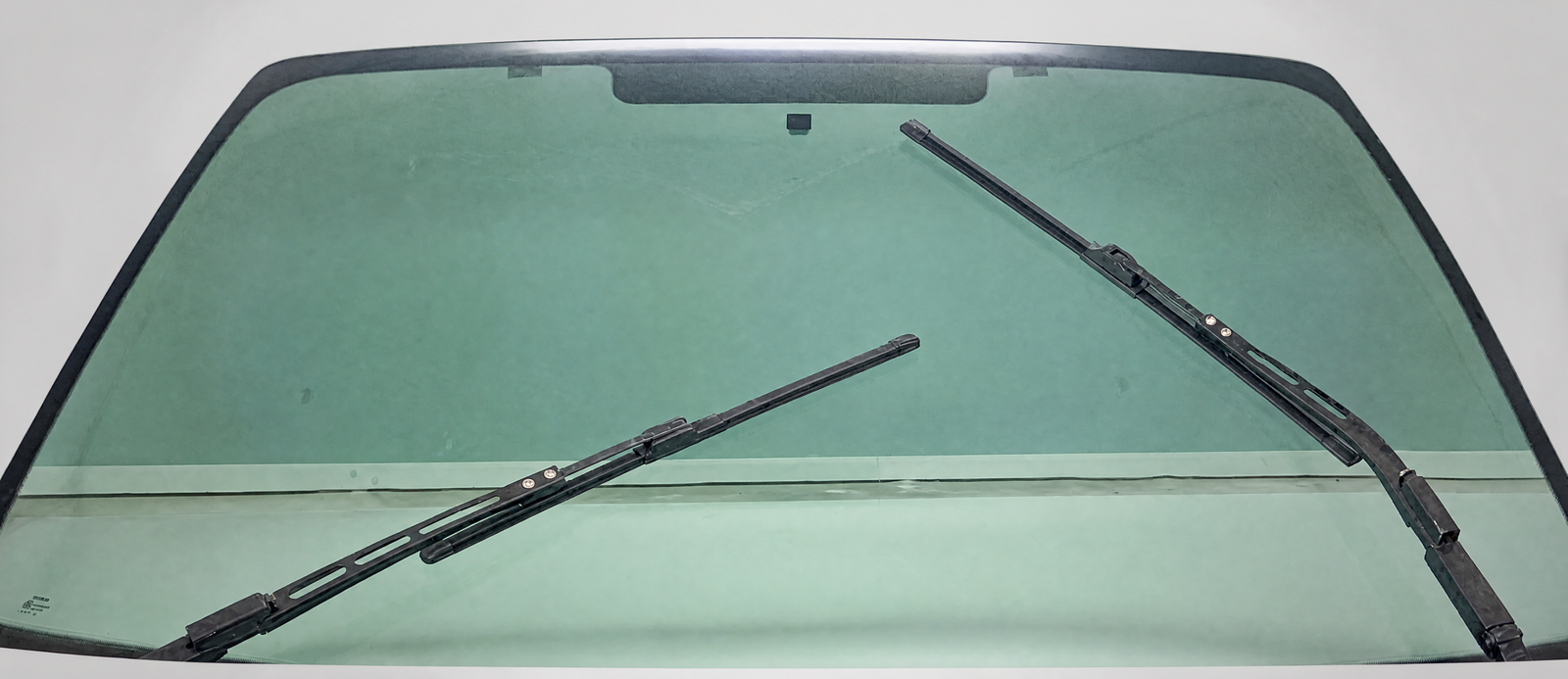
Then comes the part that governs blade design. When tested wet in accordance with SAE Recommended Practice J903a, the system must wipe a minimum percentage of Areas A, B and C — the zones defined around the driver’s field of view — measured inside a line 25 mm from the edge of the daylight opening.
| Windscreen area | Minimum share that must be wiped |
|---|---|
| Area A (primary sight line) | 80% |
| Area B (surrounding field) | 94% |
| Area C (outer field) | 99% |
Those percentages are not arbitrary. They encode a tolerance for a blade that lifts at the tip or leaves a band at the end of its travel.
Be precise about what this standard does: FMVSS 104 applies to new vehicles, not to aftermarket replacement blades. It does not certify a spare part. What it does give you is the vocabulary the industry uses whenever it argues about coverage — three areas, a 25 mm boundary, a wet test. If a supplier cannot tell you which areas their blade clears on a given windscreen, they have not measured it.
SAE J903 and J198: procedures, not badges
SAE J903 covers passenger car systems and sets out test procedures plus minimum performance requirements, including durability and frequency testing, a system stall test, and environmental resistance for temperature, wind, ozone and chemical exposure. SAE J198 covers trucks, buses and multipurpose vehicles, split by gross vehicle weight rating — above and below 10,000 lb (4,500 kg). Ozone cracking of the rubber itself is usually assessed against ASTM D1149.
Note what these documents are. A procedure and a pass line. “Our blades meet SAE J903” therefore says very little unless the supplier names which clauses were run and what came out.
Durability: what a cycle count actually means
Independent laboratories will run durability out to 1,500,000 cycles when a manufacturer wants a life prediction. One tier-one supplier publicly benchmarks 100,000 wiping cycles as roughly two years of typical use.
Two figures, an order of magnitude apart, and both can be honest. The variable is what counts as a cycle and whether the blade was conditioned first. So when you compare durability claims, ask four things:
- Wet or dry? Dry cycling is far kinder to the edge and inflates the number.
- At what frequency and temperature? A blade run at 45 cycles per minute in a warm room is not the same test as one run cold.
- Aged or fresh? Ozone, UV and heat before the run tell you about month twelve; fresh from the mould tells you about day one.
- A single figure or a curve? A blade that holds grade ten for 20,000 cycles and collapses by 40,000 is a different product from one that holds eight for 100,000.
A bare “100,000 cycles” on a specification sheet, with no conditions attached, is not comparable to anything else.
How to read the test report you are sent
Six things should be on it, and if they are missing, ask again:
- who ran the test — an in-house line check or an accredited independent laboratory;
- the exact blade identity — part number, compound batch, production date;
- the conditions — spray rate, wipe frequency, ambient temperature, blade age, wet or dry;
- the result in granular form — a grade distribution across a sample, not one number;
- images or video of the glass at the end of the run;
- the acceptance criterion that was applied, stated before the result.
Red flags: one overall grade with no conditions; “passed” with no threshold named; no images; or a test date older than the compound currently in production.
Where the bench stops
This is the part that explains most warranty claims.
A blade can grade ten on a rig and streak on a customer’s car two months later, for reasons the bench never modelled. The arm spring on a twelve-year-old vehicle has lost tension and no longer presses evenly. The windscreen carries 180,000 km of pitting that shreds an edge. The car went through a wash with hot wax. The adapter was seated one groove off and the blade now sits at an angle to the glass.
None of those are rubber failures. All of them come back as returns.
Which is why a bench result should be paired with two other things: a fitment check on real vehicles in your market, and simple instructions the end user can follow — clean the glass, replace worn arms, never run the blade on a dry windscreen. For incoming inspection more broadly, see our guide to wiper blade quality standards. If the failures you are seeing are streaking and chatter specifically, the cause sits more often in the rubber compound and the edge geometry than in the frame.
FAQ
Does a higher wipe grade mean a longer-lasting blade?
No. It means the blade wiped cleanly under the conditions tested, usually when new. Life is a separate measurement. Ask for the grade curve across cycles rather than the day-one figure.
Is FMVSS 104 certification required for aftermarket blades?
FMVSS 104 applies to new vehicles, not to replacement blades sold separately. You can still borrow its Areas A/B/C geometry and the wet test as a specification, but a supplier should not imply the standard certifies their spare part.
What cycle figure is realistic to demand?
Ask the supplier to state the conditions, then justify the number against your market. A wet run with aged blades at realistic frequency tells you more than a large dry number ever will.
Can one bench result cover both flat and hybrid constructions?
The method carries over; the results do not. A flat blade and a hybrid blade load the glass differently, so each needs its own run on the same windscreen before the two are compared.
If you are qualifying a supplier and want the test conditions written into the specification instead of promised verbally, send us the windscreen and vehicle list you are working from and we will tell you what we would run, and what the report would contain.