The first order and the tenth order are not the same negotiation, even when the product is identical. By the tenth, everything is settled: the tooling exists, the carton artwork is on file, last month’s shipment cleared. On the first, all of those things are still being decided at the same moment as the price, and that is where the friction sits.
This is written for the buyer placing that first order — the distributor adding a wiper line, the shop owner who has been buying from a local wholesaler and wants to go direct, the fleet buyer testing a cheaper source.
What an MOQ is actually made of
Ask for an MOQ and you get one number. Ask what the number is made of and you learn whether it is real.
In most factories an MOQ is the sum of several separate minimums, and any one of them can be the binding constraint:
- Blade production minimum. How many pieces a line will run before the setup is worth doing.
- Model minimum. How few pieces of a single length the factory will make. This is the one that hurts, because a wiper range needs many lengths, not many of one.
- Packaging minimum. Printing, die-cutting and blister tooling each have their own run, and those runs are frequently larger than the blade minimum.
- Order minimum. The smallest total shipment the factory will process, whether or not each model clears its own floor.
The gap between “our MOQ is 500” and “we will ship you 500 pieces across nine lengths” is the entire conversation. Ask for the breakdown per model and per packing format. A supplier who cannot break it down is quoting a number invented for your enquiry, and it will move later.
Three ways to buy a first order
| Route | What you commit to | How MOQ behaves | What drives lead time | Best when |
|---|---|---|---|---|
| Stock assortment | Existing models, neutral packing, no artwork | Lowest — you buy what is already on the shelf | Picking and consolidation | You need to test the market before spending on print |
| Private label on existing tooling | Your brand on the box, blade unchanged | Middle — blade MOQ is low, the print run is the constraint | Artwork approval plus print | You have a customer base and want your name on the shelf |
| Custom tooling | New length, new connector, or a changed profile | Highest — setup is amortised across the run | Tooling build plus validation | Volumes justify the tool, or nobody makes the part you need |
Most first orders belong in the first two rows. The common mistake is treating a custom-tooling conversation as if it were a stock conversation: the piece price looks similar, then the tooling invoice arrives, then the second order is cheaper than the first and the margin model quietly collapses.
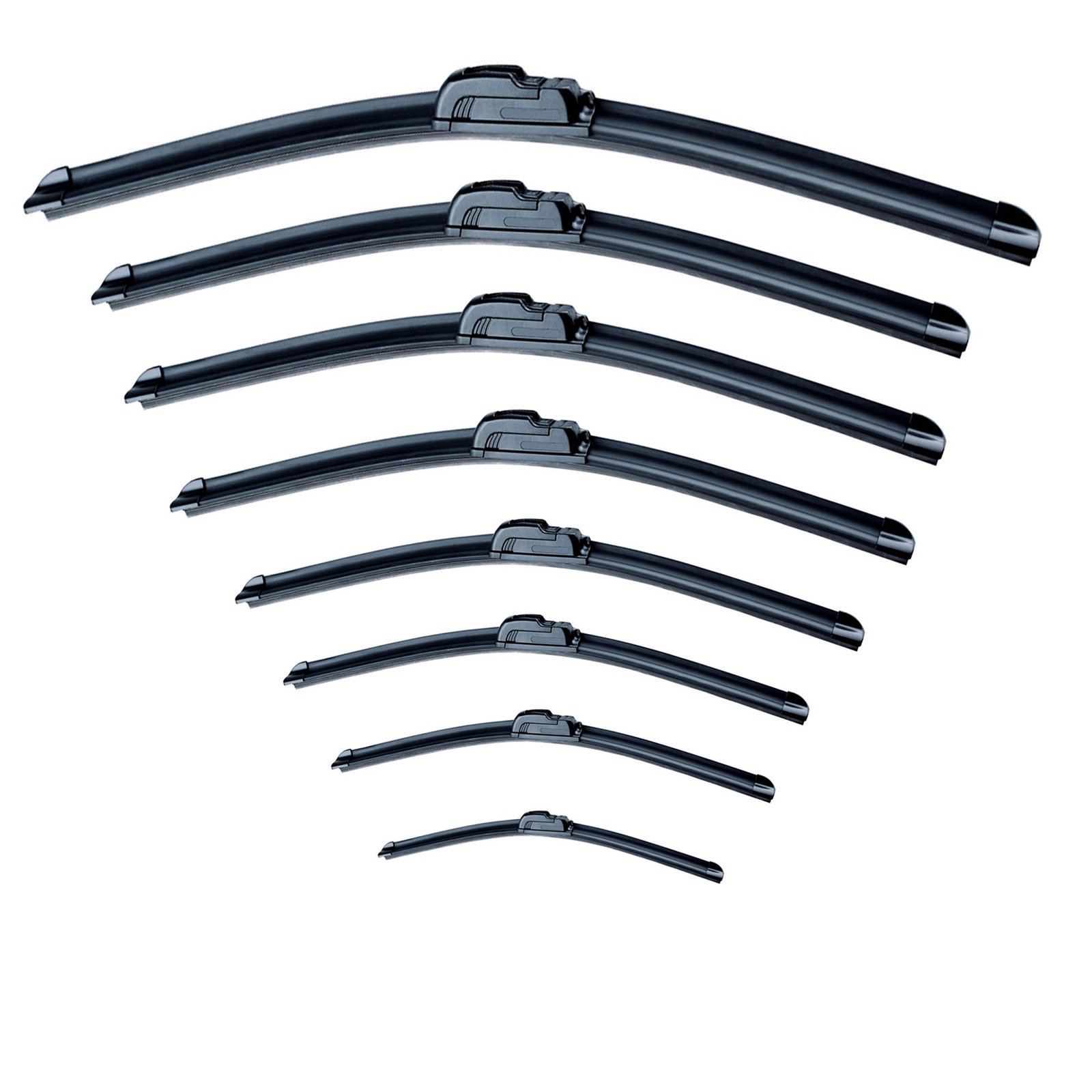
Tooling cost also depends on construction, and this is where enquiries get vague. A flat wiper blade range needs a beam tool for every length in the set. A hybrid wiper blade adds a shell mould on top of that, so the same number of lengths costs more to tool up. If your supplier quotes one tooling figure for a mixed flat-and-hybrid range without asking which is which, the figure is a guess.
The specification to settle before you ask for a price
A price without a specification is a placeholder. These are the items that move the number, and the ones worth writing into the enquiry:
| Item | Why it changes the price | What to put in the RFQ |
|---|---|---|
| Length set | Every additional length carries its own model minimum | The exact lengths in millimetres or inches, with the vehicle list behind them |
| Adapter coverage | Multi-adapter sets add parts, labour and pack complexity | Which arm types you must cover, and whether one universal set is acceptable |
| Strip compound and hardness | Compound is the largest cost lever after volume | Compound type and Shore A hardness, stated as a range you will accept |
| Dimensional tolerance | Tight tolerances slow the line and raise scrap | Tolerance on strip width and connector interface, plus the measurement method |
| Edge coating | Graphite or PTFE adds a process step | Whether coating is required, and how incoming inspection will confirm it |
| Packing format | Blister, sleeve, poly bag and carton each have separate minimums | Pack format, pieces per inner, pieces per carton, and whether the carton is printed |
| Test criteria | Decides how much inspection you are paying for | Which tests, to which standard, and the acceptance line agreed in advance |
| Artwork and language | Each market needs its own copy, warnings and barcodes | Target markets, required languages, and who supplies the barcode numbers |
Two of these cause most of the arguments later: adapter coverage and packing format. Both get quoted loosely at the enquiry stage and then specified precisely on the invoice.
What a sample can and cannot prove
A sample proves the shape fits. That is worth a lot — put it on a real arm, on a real vehicle, and watch it sweep. What a sample cannot prove is that the tenth batch will feel the same, because the sample in your hand was frequently built by hand or pulled from a pilot run.
So when you ask for samples, ask for three things:
- A production-batch sample, not a golden sample kept aside for buyers.
- The batch or lot reference, so the sample can be traced to the run it came from.
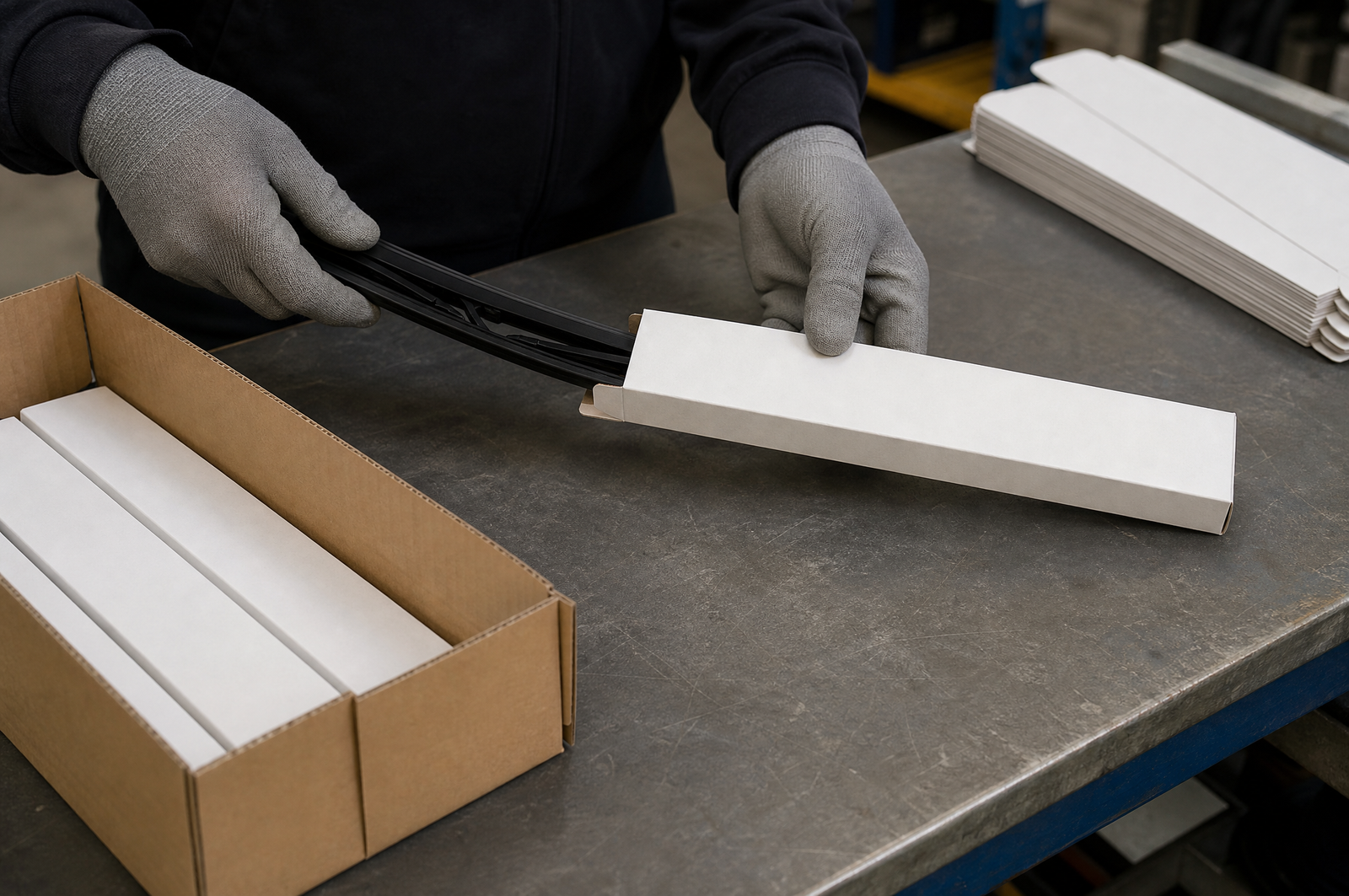
- The packing you will actually receive, because a blade that arrives bent in a poly bag tells you more about the packing than about the blade.
Then test on the vehicle rather than the bench. Park it, wet the glass, run the blade through a full sweep at both speeds, and watch the ends of the stroke — that is where a cheap blade lifts first.
Sizing the order so it survives the season
The instinct on a first order is to maximise assortment and minimise depth. That is usually right, with two constraints.
The first is the order minimum: a wide, shallow assortment can clear every model floor and still miss the shipment minimum, which leaves you choosing between dead stock and a larger order than planned. The second is the print run: if your artwork only pays off above a certain quantity, buying below it means paying a premium for the privilege of your own logo.
Work backwards from what you can sell in a season, add a modest buffer on the models you expect to run out of first, and accept that a few lengths will sit longer than you would like. Trying to make every model turn at the same rate on the first order is how buyers end up with a warehouse full of short blades nobody asks for.
Terms worth negotiating harder than the price
On a first order the price is rarely where the money is. The terms are.
- Payment structure. A deposit against production and the balance against documents is standard. What is negotiable is the split, and whether the balance can be secured against an inspection report.
- Inspection before shipment. Agree who inspects, against which criteria, and what happens if the lot fails. This is far easier to settle before the deposit than after.
- Shortage and damage allowance. Clarify how a carton-count discrepancy is handled, and whether spare units are included.
- Change notification. If the compound, the tooling or the plant changes, you want to hear about it before the goods ship.
- Second-order pricing. Ask now. A first-order price with no defined second-order price is not a price, it is an opening offer.
Where first orders actually go wrong
Rarely at the price. Usually at one of five points: the adapter was written as “universal” in the enquiry and arrived covering only the common arm; the artwork was approved as a PDF and printed at a size that did not fit the carton; the sample batch and the shipment batch came off different lines; the carton count came up short and nobody had agreed a tolerance; and the second order landed at a higher price because the first one had been a promotional quote.
All five are documentation problems rather than manufacturing problems, which is why the specification matters more than the discount.
If you are still comparing factories at this stage, the questions that separate them are set out in how to choose a wiper blade supplier. For the packing side — artwork formats, dielines and what actually prints cleanly — see custom wiper blade packaging. And once the order is placed, the freight, duty and clearance sequence is covered in how to import wiper blades from China.
FAQ
Can I order below the stated MOQ?
Sometimes, at a higher unit price and usually with neutral packing. Ask directly rather than assuming the listed number is fixed — but treat a yes as a prompt to ask why the minimum existed, because it is usually protecting a setup cost that will come back somewhere else.
Should the first order be private label or neutral?
Neutral, unless you already have customers waiting. Artwork, barcodes and market-specific warnings add cost and delay, and they are much easier to get right once you know which lengths actually sell for you.
How many lengths should a first order cover?
Enough for the top-selling vehicles in your market and no more. A narrow, deep range is easier to replenish and far easier to explain to a customer than a wide, shallow one.
Getting a quote that holds
If you are assembling a first order and want the specification pinned down before the price, send us the vehicle list, the lengths and the packing format you have in mind. We will tell you what the MOQ is actually made of, which parts of the range we already tool, and where a custom tool would genuinely be needed.