Two buyers can order a blade that looks identical on a quotation and end up with very different products. One clears snow at -25 °C for a full season. The other chatters, streaks and produces returns by January. The difference is almost never the price — it is the specification decisions made before the order was placed.
This guide walks through those decisions in the order they should be taken: climate first, then blade construction, then strip compound, then length and connector coverage, then how to read a specification sheet and compare two offers fairly, and finally how the product format should change depending on the channel you sell into.
1. Start from your climate, not from the price list
The most common buying error in winter wiper programmes is treating “winter” as a single condition. It is not. A market that sees a handful of frosty mornings is a different requirement from a market that sits below -20 °C for three months, and the two should not be buying the same blade.
Before looking at any catalogue, answer three questions about the market you actually serve.
How low does it really go? Not the record low in the national statistics, but the lowest temperature at which people still drive to work. A blade is only judged on the mornings people use it.
How much snow and ice falls on the windscreen? Heavy wet snow packs into frame joints and refreezes; dry powder blows off and matters less. Ice is what locks a linkage.
How long does the season run? A six-week season justifies a limited winter line alongside all-season stock. A five-month season usually justifies a dedicated winter range and a full seasonal plan.
Getting these wrong in either direction costs money. Over-specifying a mild market raises the unit cost and prices you out of the shelf. Under-specifying a severe market generates the returns and complaints that no margin can absorb.
2. Climate tiers and the blade configuration that fits
The table below is a starting point for matching configuration to climate. Treat it as a buying framework, then confirm the specifics with your supplier against your own vehicle list.
| Climate tier | Typical winter conditions | Configuration to choose |
|---|---|---|
| Occasional frost | A few freezing mornings, little or no snow accumulation | A quality all-season blade with a low-temperature strip; a full winter line is usually unnecessary |
| Regular sub-zero | Sustained sub-zero nights, regular snow, salt on the roads | Enclosed winter blade with a low-temperature compound and corrosion-protected frame |
| Sustained deep winter | Months below -10 °C, heavy snow, long ice season | Enclosed winter blade with a low-temperature compound; corrosion protection is a hard requirement, not an option |
| Extreme winter | Long periods below -20 °C, freeze-thaw cycles, heavy road salt | Enclosed winter blade, low-temperature compound selected for the coldest end of the range, fully sealed linkage and verified cold-start flexibility |
3. Choosing the strip compound for your lowest expected temperature
The strip is the only part that touches the glass, which makes it the part that decides whether the blade works on a cold morning.
Natural rubber blends that feel soft and compliant at room temperature stiffen as the temperature falls. Once the strip is too stiff to follow the curvature of the windscreen, the contact line breaks into arcs and the ends of the swept area stay wet — the classic winter complaint. The symptom looks like a manufacturing defect; the cause is a specification mismatch.
So ask a specific question rather than a general one. “Is this a winter blade?” invites a yes. “At what temperature does the compound stop conforming to the glass, and how was that verified?” invites an answer you can use.
Two further points are worth building into your buying decision. A graphite or similar surface treatment on the strip reduces running friction, which matters more in cold weather because the blade is starting from a stiffer state. And the strip specification should be matched to the coldest conditions your market sees, with a margin — a blade specified to exactly the average winter low will under-perform in the fortnight that decides whether the customer reorders.
If your range also covers all-season demand, the same logic applies to flat blades and hybrid blades; the construction differs, but the principle of matching compound to climate does not.
4. Matching length and connector coverage to your vehicle list
Length and connector are where a good product becomes a sellable range — or does not.
Work backwards from the vehicle list you are targeting, not forwards from the catalogue. A winter range built to cover two or three high-volume applications properly will out-sell a broad catalogue that misses them. Confirm sizes in both inches and millimetres, because two suppliers describing the same blade will use different units, and a range that looks complete in one unit can have gaps in the other.
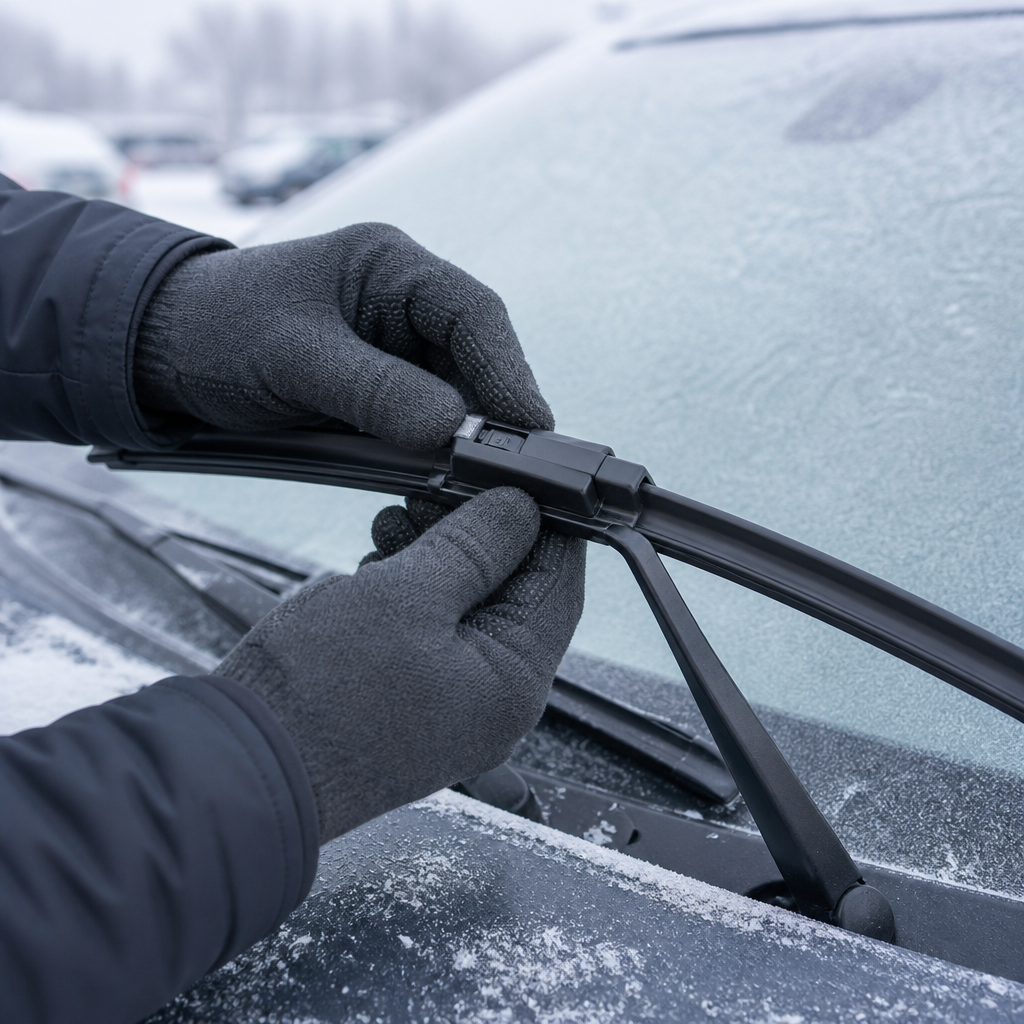
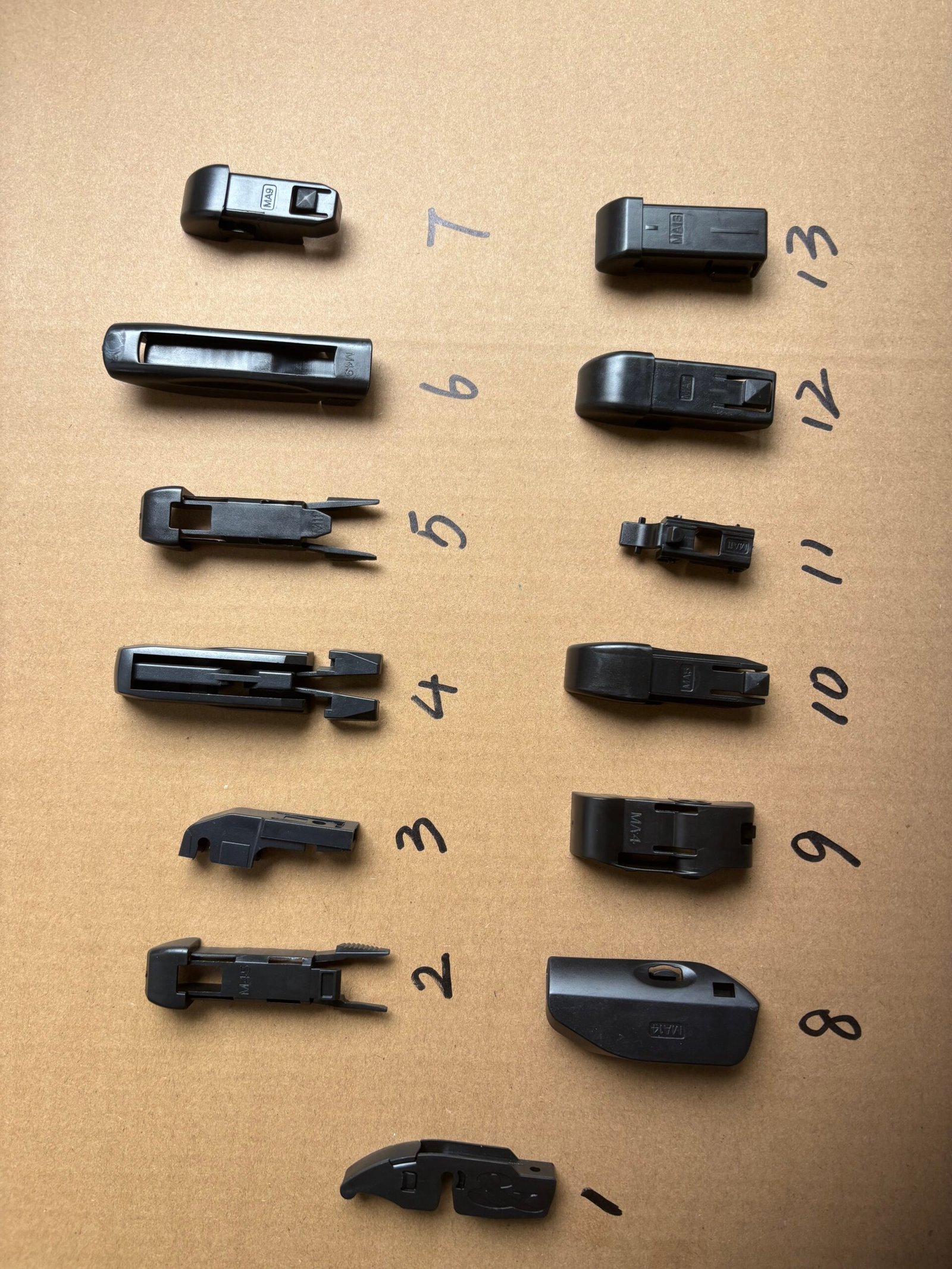
On connectors, four families cover most of the fleet: U-hook on the older vehicles that most often need replacement, pinch tab and push button on newer platforms, and Top Lock on some Japanese and Korean applications. A universal adapter set lets one SKU serve more vehicles, but the adapters should be checked for fit and retention at low temperature — a plastic clip that seats easily in a warm workshop can become stiff and awkward to lock in the cold.
For the deeper qualification questions — what to verify with the factory, what test documentation to request, and how to time the order — see our cold-climate sourcing guide for distributors.
5. How to read a winter wiper specification sheet
A useful specification sheet is boring and specific. Marketing material is exciting and vague. The distinction is a fast way to shortlist suppliers.
A sheet you can actually buy from states the strip compound family, the frame or boot material, the full length range in both units, the list of connectors supplied, the packaging format, the minimum order quantity, the lead time, and the test evidence available. If it opens with adjectives about performance and closes without a single material or dimension, you have a brochure, not a specification.
Ask for the documents alongside the quotation: low-temperature flexibility evidence, corrosion test reports, ageing test data, and the manufacturer’s quality-system certificate. A supplier who has these can usually produce them quickly. One who does not will explain why the request is difficult.
6. Comparing offers fairly: what to normalise before you decide
Unit price is the least useful number in a quotation until everything around it is the same. Before comparing two offers, normalise the following:
- The length set. Twelve sizes in one offer and nine in another are not the same range, even at the same unit price.
- The connector kit. Confirm what is included in the box or the carton, not what is available on request.
- The packaging. Retail blister, colour box and bulk carton carry different costs and serve different channels.
- The trade term. FOB and CIF quotations are not comparable without the freight component.
- The MOQ basis. A price quoted at 10,000 pieces does not apply at 2,000.
- The documentation. Test reports and certificates are part of the deliverable, not a favour.
Once those are aligned, the price comparison becomes meaningful — and it frequently reverses the ranking you started with.
7. Choosing the format for your channel
Winter blades are sold through several channels, and the right product for each is not the same. The format decision drives packaging, SKU count and price point, so it belongs in the buying decision, not after it.
| Sales channel | What the buyer expects | Winter range to stock |
|---|---|---|
| Retail / DIY | Easy identification of the correct size, retail-ready packaging | A curated range covering the top-selling lengths with clear fitment guidance |
| Workshop / fitting bay | Fast fitment, reliable connector coverage, dependable repeat supply | Fewer SKUs, deeper stock, and a connector set that covers the common arm types |
| Fleet operator | Predictable performance across many vehicles, low failure rate | A defined set of lengths and connectors matched to the fleet’s vehicle list, with documented specifications |
| Online / marketplace | Accurate listing data, consistent packaging for shipping | Precise size and connector data per SKU, plus packaging that survives parcel handling |
8. Five common buying mistakes
Buying on unit price without normalising. As above: the cheapest quotation is often the one with the thinnest range or the flimsiest packaging.
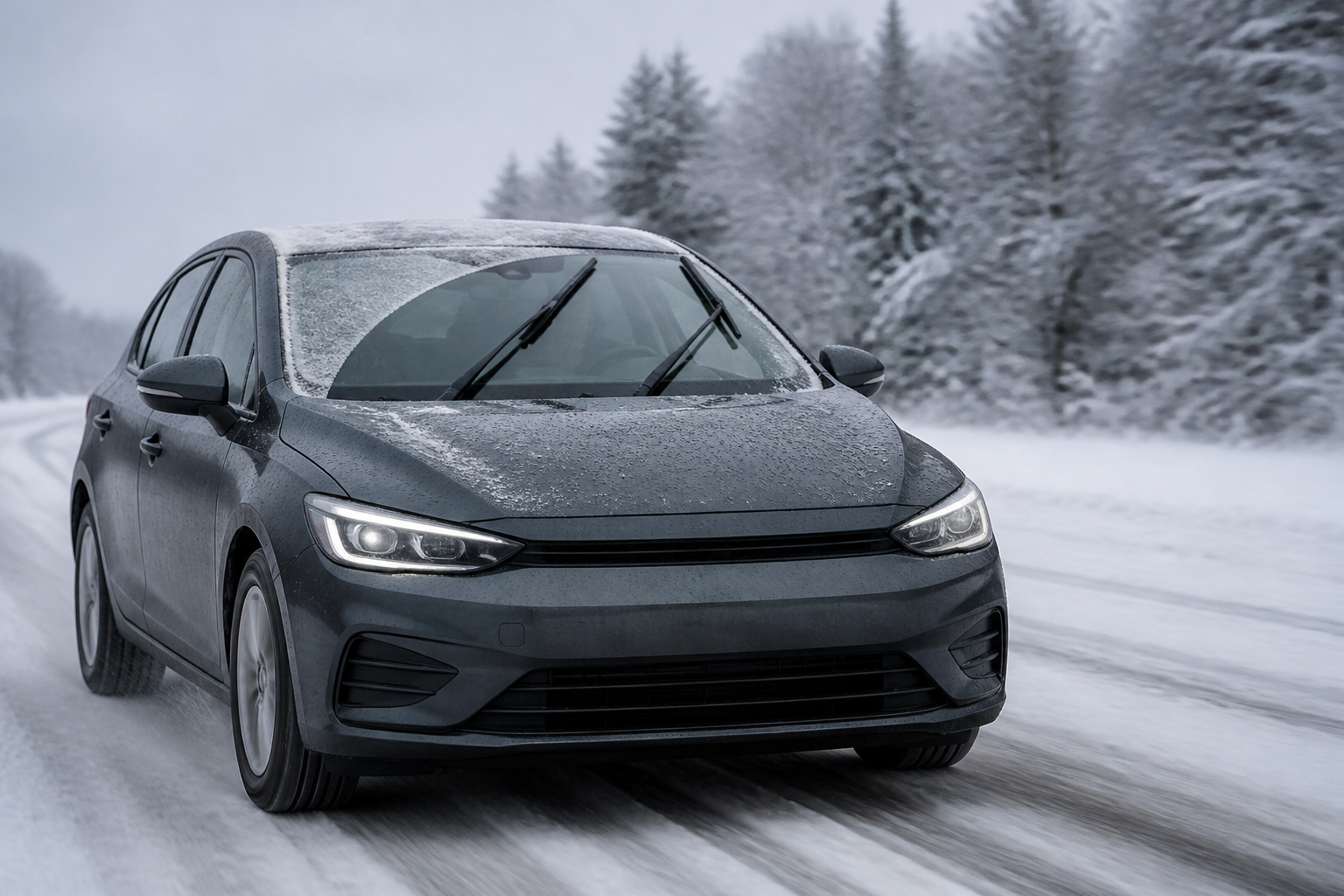
Treating “winter” as a label rather than a construction. A standard blade in winter packaging will fail in a genuine winter market, and the failure will arrive as a customer complaint rather than a credit note.
Ordering too late. Winter demand is weather-driven and concentrated, and ocean freight plus clearance plus inland distribution takes weeks. Late orders become stock-outs in the busiest month.
Choosing the widest range instead of the highest-volume coverage. Range breadth looks impressive in a catalogue and creates slow-moving stock in the warehouse.
Leaving packaging to the last minute. A change of format after the production schedule is set resets the schedule. Multi-language labelling requirements are common in cold-climate markets and should be settled with the order, not after it.
9. FAQ
Is a winter blade always more expensive than an all-season blade?
The bill of materials is different — an enclosed frame and a low-temperature compound both add cost — so the unit price is normally higher. The meaningful comparison is against the cost of the winter returns and complaints a standard blade produces in a cold market.
Can I use one specification for every cold-climate market I serve?
Rarely. The lowest expected temperature, the snow load and the vehicle mix all differ between markets. Use the climate tier as the starting point, then confirm the length and connector coverage against the specific vehicle list.
How do I know whether a supplier’s winter blade is genuinely engineered for cold weather?
Ask for the compound family, the frame or boot design, and the low-temperature test evidence in writing. A supplier who has engineered the product for cold conditions can describe how, and can show the documentation.
What should I settle before placing the first order?
Climate tier, length set, connector kit, packaging format, documentation requirements, MOQ and delivery window. Agree them in writing, then compare offers on that basis.
If you would like help matching a specification to your market, send us your target vehicle list and climate conditions and we will come back with a proposed winter range.