Most wiper programs are built around the front pair. The rear blade is treated as an accessory — ordered late, stocked thin, and frequently the line item that generates the highest rate of “wrong size” complaints per unit sold. For distributors, importers and aftermarket chains, that is an expensive oversight. Rear blades are cheap to stock, rarely fail on performance grounds, and they attach a customer to your catalogue for a second purchase.
This guide covers what actually changes when you source rear window wiper blades: how they age, the 9”–16” size window, connector coverage, the tests worth demanding, and how to plan an assortment that sells through instead of sitting in the warehouse.
1. Rear blades fail on a different curve
Front blades work under load and constant use. Rear blades spend most of their life parked on glass that is directly exposed to sunlight, dust and road film, and they are used in short bursts at low speed when reversing or when the rear screen is obscured.
Three consequences follow for buyers:
- UV and ozone aging matter more than abrasion. A rear blade can look almost unworn while the rubber has already hardened. The hardening shows up as chatter and streaks on the first heavy rain of the season.
- A low duty cycle hides defects. A rear blade may complete only a few hundred sweep cycles in a year. A marginal rubber compound will not be exposed by cycle testing alone — you have to test for ageing.
- Contamination is heavier. Dust, tree sap and dried washer residue sit on the rear screen far longer than on the windshield, so the blade edge deforms before it wears out.
A rear blade program therefore rewards suppliers who can evidence ageing and temperature testing, not only sweep counts.
| Sourcing factor | Front wiper blade | Rear window wiper blade |
|---|---|---|
| Typical size range | 16”–28” | 9”–16” |
| Duty cycle | High, frequent | Low, intermittent |
| Dominant ageing driver | Abrasion and UV | UV, ozone, contamination |
| Fitment complexity | Several arm families | Many vehicle-specific arms and clips |
| Stock depth strategy | Deep on high-runner sizes | Wide but shallow across the range |
| Most common return cause | Wear-out and streaking | Wrong size or arm mismatch |
2. The 9”–16” size window
Rear blades cluster into a narrow band, which makes assortment planning simpler than the front pair — provided you work from millimetre lengths rather than rounded inch labels.
| Inch | Millimetre | Typical application |
|---|---|---|
| 9” | 225 mm | Compact hatchbacks |
| 10” | 250 mm | Small hatchbacks, city cars |
| 11” | 275 mm | Hatchbacks, small MPVs |
| 12” | 300 mm | Most hatchbacks and small SUVs |
| 13” | 325 mm | MPVs and compact SUVs |
| 14” | 350 mm | SUVs and estates |
| 15” | 375 mm | Large SUVs, vans |
| 16” | 400 mm | Large estates and light commercial |
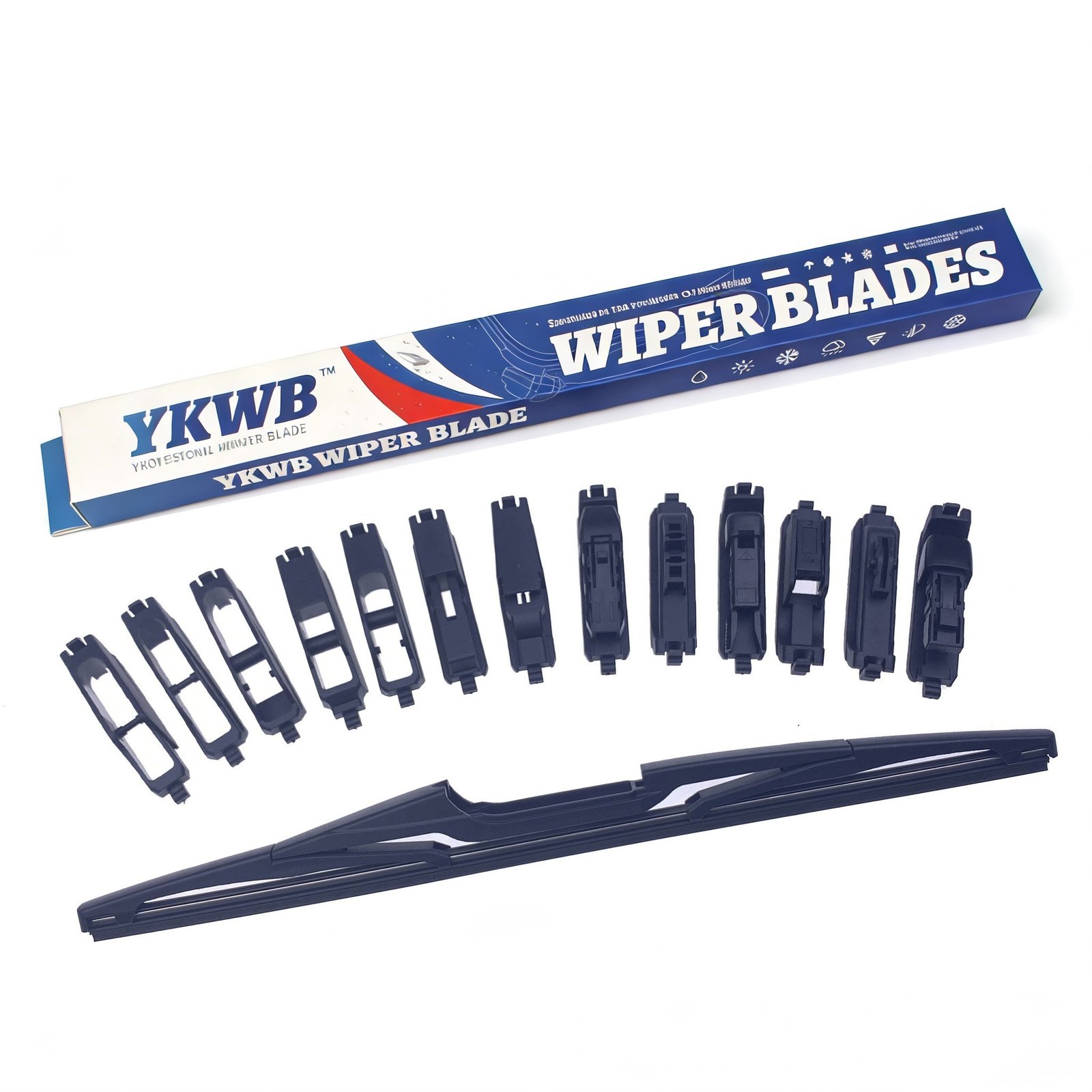
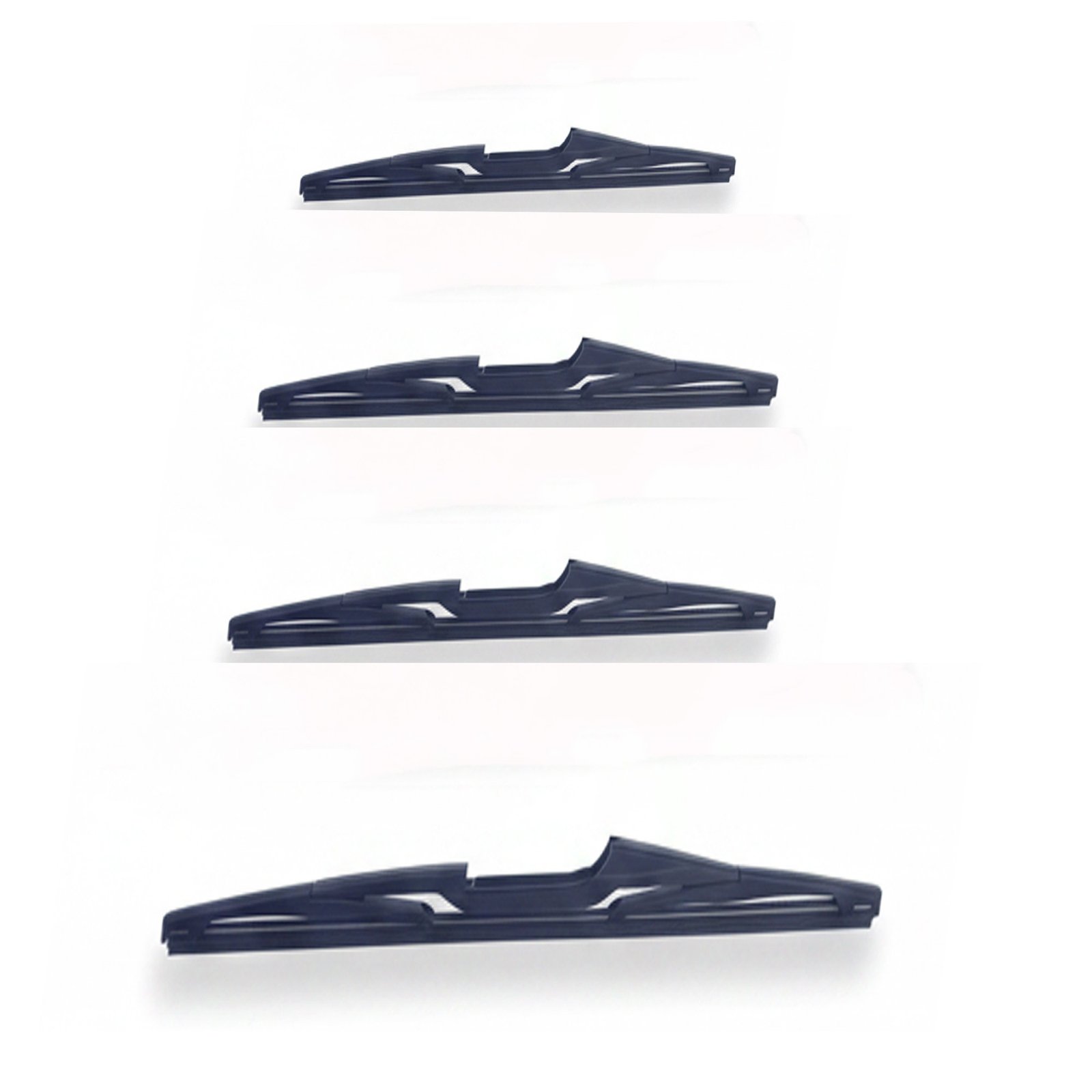
Because the band is narrow, distributors normally need coverage at every inch step rather than skipping sizes. A missing 12” or 13” entry is usually a lost sale rather than a substitution: the arm geometry on compact hatchbacks rarely allows a longer blade to park correctly against the tailgate glass.
3. What to specify for rear blades
Rubber compound. Rear blades sit in sunlight for years and are used rarely, so the compound has to resist hardening rather than abrasion. Ask for the ageing test data behind the claim, not just the hardness value on the specification sheet.
Connector and frame material. Rear blades are often exposed to direct sun through glass. Polypropylene and general-purpose plastics that are not UV stabilised become brittle within a season or two, and a snapped connector is a warranty return even though the rubber is still serviceable. Specify UV-stabilised engineering plastic for the connector housing and a corrosion-protected frame.
Connector coverage per SKU. Rear arm interfaces vary widely between vehicle families, and this is the single biggest driver of fitment returns. A rear blade supplied with a fixed connector limits your catalogue to one vehicle family; a multi-adapter rear blade covers far more applications per SKU and reduces the number of part numbers you must hold. Our rear window range (YK-8 series) is supplied as a multifunctional platform with an adapter set covering the common rear arm types in the 9”–16” range.
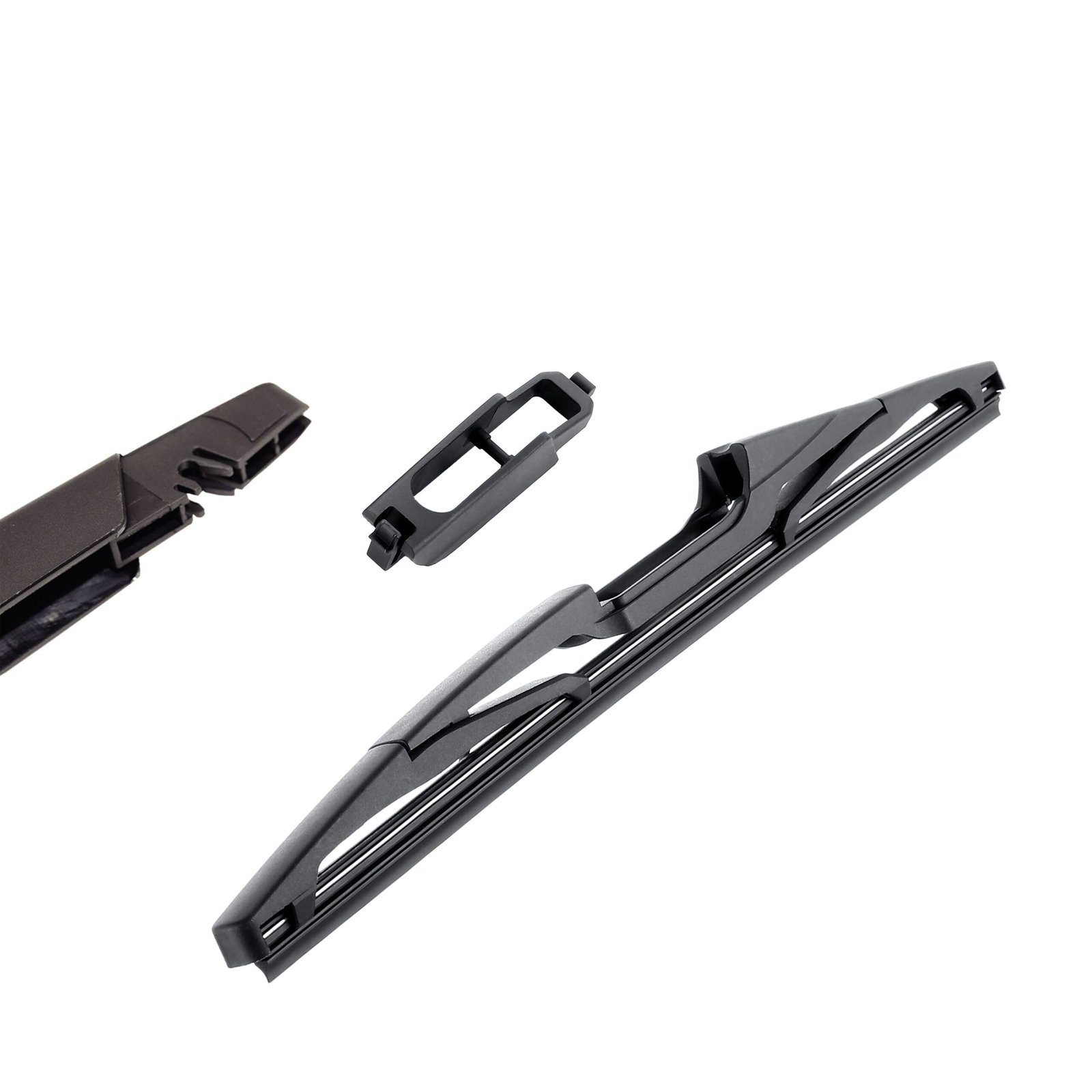
Length tolerance and curvature. Rear screens are small relative to blade length and usually more curved, so a blade that is straight rather than pre-curved can lift at the ends and leave an unwiped arc exactly where the driver looks when reversing.
Noise. Rear blade noise is more noticeable than front noise because there is less wind and engine noise to mask it. A squeaking rear blade generates complaints disproportionate to its price.
4. Testing and certification worth demanding
For a component this cheap, buyers rarely audit the factory. That is a mistake, because the failure modes are all measurable. Ask for evidence on the following:
- Accelerated UV weathering — confirms the rubber and the connector survive sustained sunlight without hardening or becoming brittle.
- Ozone ageing — ozone cracking is a leading cause of rear blade failure in coastal and high-altitude markets.
- Salt spray corrosion testing — relevant for the frame and any metal components in winter-salt and coastal regions.
- Cold flexibility — rubber that stiffens in low temperatures will skip rather than wipe. Our rear and multifunctional blades are tested for flexibility down to -40°C.
- Noise measurement — a documented noise figure such as ≤35 dB gives you an objective basis for a premium claim.
- IATF 16949:2016 certification — the automotive quality management standard, and the clearest single indicator that the factory runs a controlled process rather than batch inspection.
Zhejiang Yike Auto Parts operates an in-house test lab covering the wiper test bench, salt spray chamber, UV accelerated weathering tester and ozone ageing chamber, and holds IATF 16949:2016 certification. The same lines supply OEM programs including SAIC-GM and aftermarket programs for Honda Japan.
5. Planning an assortment that sells through
A practical starting point for a distributor entering rear blades:
- Cover every inch step from 10” to 14” — this band accounts for the bulk of applications in most markets.
- Add 15” and 16” for SUV and light commercial coverage, but keep depth shallow.
- Standardise on one multi-adapter platform rather than stocking vehicle-specific part numbers in every size.
- Hold the widest adapter coverage on your fastest-moving size, since that is where mixed applications concentrate.
- Price the rear blade as an add-on to the front pair: rear blades attach to an existing purchase rather than generating a separate buying trip.
6. Packaging and private label
Rear blades are frequently sold from a hanging rack, so packaging decisions are visible:
- Blister packs protect the rubber and present well in retail, but cost more per unit and take volume in transit.
- Slide cards suit hanging display, reduce material cost and work well for eco-positioned ranges.
- Colour boxes support private-label branding and multi-language specifications, and are the usual choice for distributor brands.
Whatever format you choose, confirm that the label carries the length in both inch and millimetre terms and the list of vehicles covered by the supplied adapter set. Most rear blade returns are fitment complaints that a clearer label would have prevented.
7. Buyer checklist
- Length stated in both inch and millimetre
- Adapter set included and clearly documented
- UV and ozone ageing test data available
- Cold flexibility figure for your coldest market
- Noise measurement, ideally under 40 dB
- IATF 16949:2016 certificate on file and current
- Packaging format matched to your sales channel
FAQ
Can I use a front blade cut to length on the rear screen?
No. Rear arms use different connectors, and the curvature and parking position differ. Use a blade designed for rear fitment.
How often do rear blades need replacing?
In practice less often than the front pair, but ageing rather than mileage drives the decision. Rubber exposed to strong sun hardens within one to two years.
Why does my rear blade chatter but leave no visible wear?
Chatter with an unworn edge is the classic signature of hardened rubber, which is why ageing tests matter more than cycle counts in this category.
Should I stock vehicle-specific rear blades?
Only for high-runner applications. A multi-adapter platform gives broader coverage from a smaller number of SKUs.
Which rear blade sizes sell best?
In most markets the 11”–14” band dominates, with 12” the single most common size.
Looking for a rear wiper blade supplier?
If you are adding a rear blade line to your catalogue, we can supply the 9”–16” range as a multifunctional platform with adapter coverage, tested for UV and ozone ageing and supplied under your own label.
Related reading: hybrid wiper blades and flat wiper blades for front-pair programs.