The Complete Windshield Wiper Buyer’s Guide: Types, Compatibility, Materials & OEM Sourcing Strategy


Selecting the correct wiper blade architecture is the first consequential engineering decision. Three primary designs dominate the global aftermarket:
| Architecture | Pressure Distribution | Aero Performance | Winter Performance | Typical Unit Cost |
|---|---|---|---|---|
| Conventional | Uneven; discrete contact points | Low — lifts above 100 km/h | Poor — frame ices over | Lowest |
| Beam (Frameless) | Superior — continuous full-length | Excellent — no external structure | Good — no frame to ice | Moderate–High |
| Hybrid | Good — improved over conventional | Good — shell deflects airflow | Moderate | Moderate |
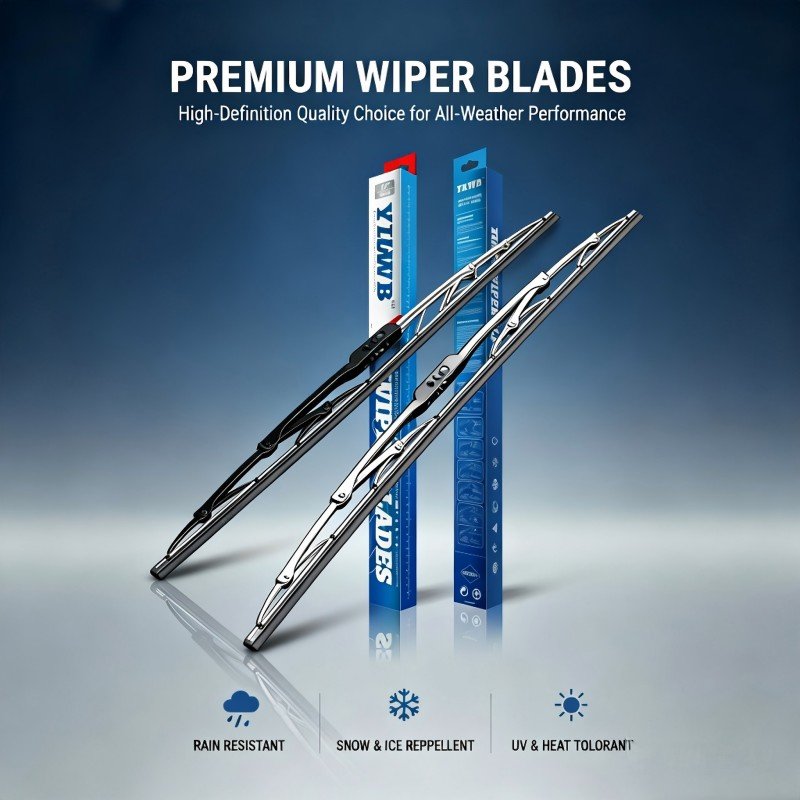
The conventional blade uses an external steel frame with multiple pressure-bearing contact claws. At high speeds, aerodynamic lift acts on the frame, reducing contact pressure and causing chattering.
Conventional vs. Beam structure — contact pressure distribution
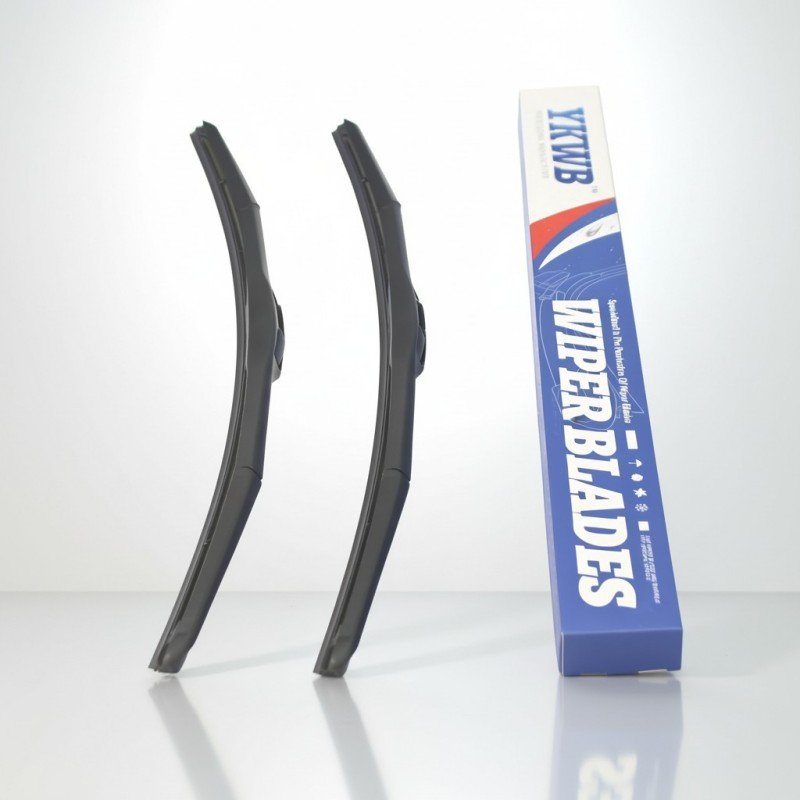
Beam blades eliminate the external frame. An internal spring steel tensioner applies continuous, evenly distributed downward pressure across the contact edge, ensuring performance at speeds exceeding 200 km/h.
Combining an aero shell with an internal frame, hybrids offer a mid-market position with improved aesthetics and airflow deflection.
The wiper lip must remain flexible across -40°C to +80°C. Three formulations lead the industry:
Wiper blade rubber cross-section — multi-layer material engineering
The frame steel determines the static pressure profile. Beam blade tensioners are heat-set to a curvature radius matching common windshield profiles — typically 1,000 mm to 3,000 mm radius to prevent “fish-tailing” wipe patterns.
The global fleet uses over 20 distinct wiper arm configurations. Our engineering team has simplified this into a universal adapter set:
| Connector Type | Common Applications | Key Identification Feature |
|---|---|---|
| J-Hook | Most European & American vehicles | Curved hook — most common globally |
| Pinch Tab | Ford, Lincoln (North America) | Side-release squeeze tab |
| Top Lock | GM, Chrysler (North America) | Locks from the top |
| Slim Top | Toyota, Lexus (Asia/Global) | Narrow flat profile |

Universal adapter set — covering 99% of global vehicle applications
| Climate Zone | Stress Factor | Recommended Rubber | Expected Life |
|---|---|---|---|
| Temperate (Europe/Asia) | General rain | EPDM | 12–18 months |
| Tropical (SE Asia) | Heat & UV | Silicone or EPDM | 12–24 months |
| Snow & Ice (North) | Sub-zero stiffness | Cold-compound EPDM | 10–14 months |
| Desert (Middle East) | Extreme heat/UV | Silicone | 24–36 months |
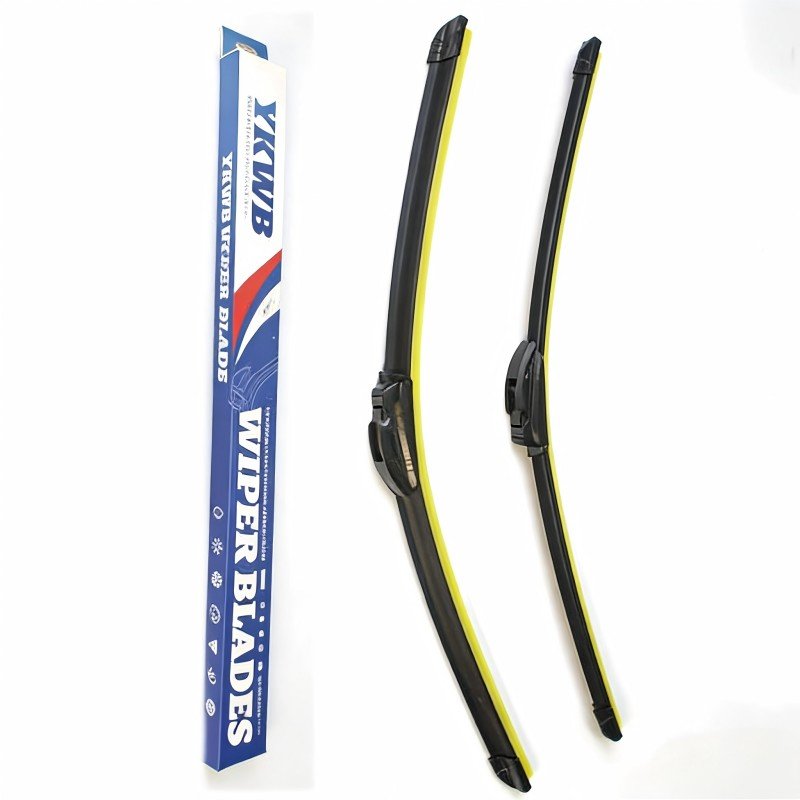
OEM private label packaging — retail-ready with custom branding
Engage directly with the engineers who control rubber compounding, frame forming, and adapter injection under one roof.
Request a Free Quote →Q: What is the main benefit of Silicone blades?
A: Silicone lasts 2x longer and applies a water-repellent coating to the glass as it works, improving visibility even when the wipers are off.
Q: How do I handle 20+ different wiper arms?
A: Our universal adapter system covers 99% of global vehicles with just 10-14 connectors, simplifying your inventory management.
Q: What certifications should a supplier have?
A: Baseline: IATF 16949. Market-specific: ECE R43 (Europe), SAE J903 (USA), CCC (China).
WhatsApp us